Risk Management Basics: Position Sizing Before You Trade Live
SEBI’s own study found that roughly 9 in 10 individual F&O traders lost money net of costs. The single highest-leverage fix available to a retail trader isn’t a better entry signal — it’s a position sizing rule applied consistently.
1. The Fixed-Fractional Rule
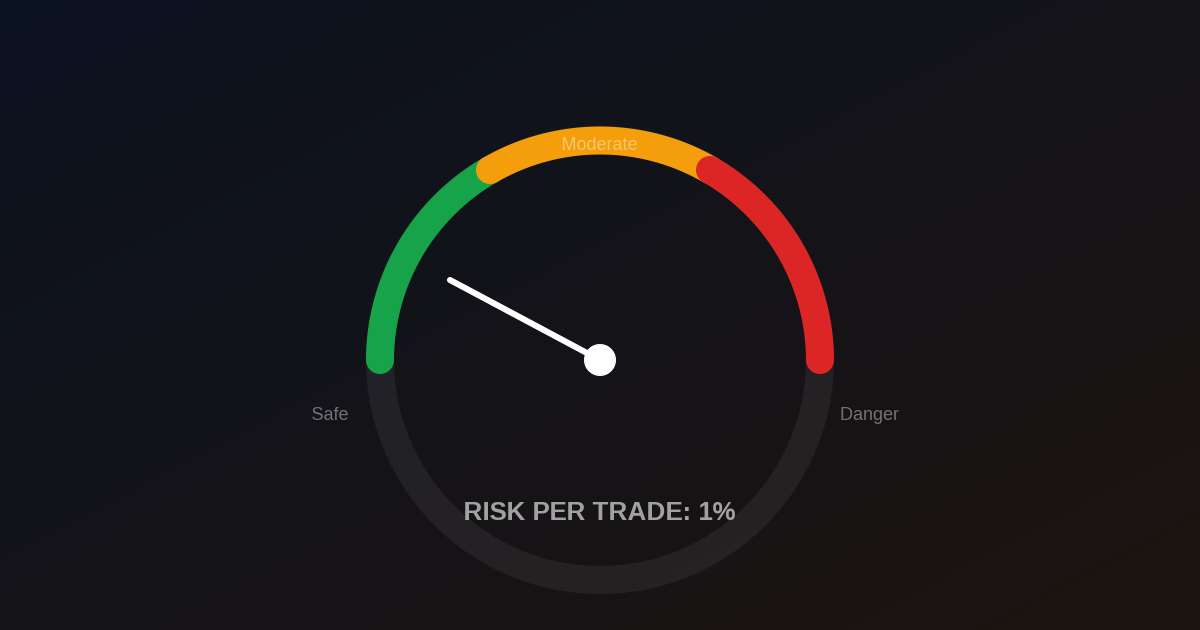
Risk a fixed, small percentage of total trading capital per trade — commonly 1-2% — regardless of how confident you feel about the setup.
def position_size(capital, risk_pct, entry_price, stop_loss_price, lot_size=1):
    """
    capital: total trading capital in rupees
    risk_pct: fraction of capital to risk per trade (e.g. 0.01 for 1%)
    entry_price, stop_loss_price: per-unit prices
    lot_size: contract lot size (e.g. NIFTY = 75 as of recent cycles; verify current lot size)
    """
    risk_amount = capital * risk_pct
    risk_per_unit = abs(entry_price - stop_loss_price)
    if risk_per_unit == 0:
        raise ValueError("Entry and stop-loss cannot be equal")

    units = risk_amount / risk_per_unit
    lots = int(units / lot_size)
    return max(0, lots)

lots = position_size(
    capital=500_000,
    risk_pct=0.01,
    entry_price=150,
    stop_loss_price=110,
    lot_size=75,
)
print(f"Max lots for this trade: {lots}")
Notice what this does automatically: a wider stop (less certain setup, or more volatile instrument) produces a smaller position. You never have to manually remember to “size down” for a riskier trade — the formula does it.
2. Why 1-2%, Not 5% or 10%
The math of drawdown recovery is asymmetric — a loss requires a disproportionately larger gain to recover:
| Loss | Gain needed to recover |
|---|---|
| 10% | 11.1% |
| 25% | 33.3% |
| 50% | 100% |
| 75% | 300% |
At 2% risk per trade, a string of 10 consecutive losing trades costs ~18% of capital (compounding) — painful but recoverable. At 10% risk per trade, the same losing streak is effectively account-ending. Most new traders find out about this curve from experience rather than from reading it first.
3. Risk Per Trade Is Not the Same as Capital Deployed
A common confusion: “I only put 5% of my capital into this trade” is not the same statement as “I’m only risking 5% of my capital.” If the position has no stop-loss, or the stop is far from entry, the capital deployed can be small while the realized risk on a gap move is much larger — especially relevant for NSE options, which can gap significantly overnight or at market open.
4. A Practical Weekly-Options Adjustment
Flat percentage risk assumes a clean, known stop-loss distance. For weekly options where you might exit on a 50% premium stop rather than a price-based stop, adapt the calculator:
def options_position_size(capital, risk_pct, premium, stop_loss_fraction, lot_size):
    risk_amount = capital * risk_pct
    risk_per_lot = premium * stop_loss_fraction * lot_size
    lots = int(risk_amount / risk_per_lot)
    return max(1, lots) if risk_per_lot > 0 else 0

# Risking 1% of capital, stopping out at 50% of premium paid
lots = options_position_size(
    capital=500_000,
    risk_pct=0.01,
    premium=85,
    stop_loss_fraction=0.5,
    lot_size=75,
)
print(f"Max lots: {lots}")
5. One Rule, Applied Consistently, Beats a Better Signal Applied Inconsistently
This is intentionally basic — no indicators, no entry logic. It’s the layer that determines whether you’re still trading six months from now regardless of which strategy you pair it with. For a volatility-aware version of this same idea, see GARCH(1,1) Volatility Forecasting for Position Sizing.
Important Notice & Educational Purpose: XAlgoPro (xalgopro.com) and its authors/contributors are NOT SEBI registered Research Analysts (RA) or Investment Advisers (IA) under the SEBI (Research Analysts) Regulations, 2014, or SEBI (Investment Advisers) Regulations, 2013.
All content, algorithmic logic, indicators, Pine Script codes, Python scripts, statistical models, mathematical formulas, and backtest results presented on this platform are published strictly for educational, academic, and technological research purposes only. Nothing on this website constitutes investment advice, financial guidance, an offer, recommendation, or solicitation to buy or sell any security, derivative, contract, or financial instrument on the National Stock Exchange (NSE), Bombay Stock Exchange (BSE), or any other global exchange.
SEBI Statutory Risk Disclosure on Derivatives (F&O):As per SEBI study on Intraday & Derivatives trading, 9 out of 10 individual traders in the Equity Futures and Options (F&O) segment incurred net losses, with an average loss of over ₹50,000 per trader. Over and above net trading losses, loss-makers expended an additional 15% to 50% in transaction fees, brokerage, and statutory taxes (STT, GST, Stamp Duty). Trading options and futures involves substantial financial risk, leverage, and potential loss of entire invested capital.
Past algorithmic backtest performance or hypothetical simulations do not guarantee or represent future live trading results. Readers and users must perform their own independent due diligence, test thoroughly in simulated/paper trading environments, and consult an authorized SEBI Registered Financial Advisor before risking actual capital in Indian equity or derivatives markets. You are solely responsible for all trading decisions, capital allocations, and monetary risks undertaken.